Thanks for being here! Everyday Folkways is a local resource in support of everyday folks turning to skills and activities to meet their everyday needs. Every month, we host a project circle and publish this newsletter, connecting the community with skills, resources, and events.
What’s been going on:
This month, I had the chance to table at the Master Recycler Composter’s Repair Fairat Chehalis Outfitters. It was a cool event! There were folks running sewing machines, repairing mowers, sharpening tools, fixing electronics — I even got a flannel I’ve long meant to patch fixed by one of those sewing machinists. I also got a chance to connect with other organizations, but mostly I enjoyed surprising people with a spinning wheel and giving kids bean pods to crack open and take home. If you know of a community event I should set up at, let me know — I had a great time and would do it again.
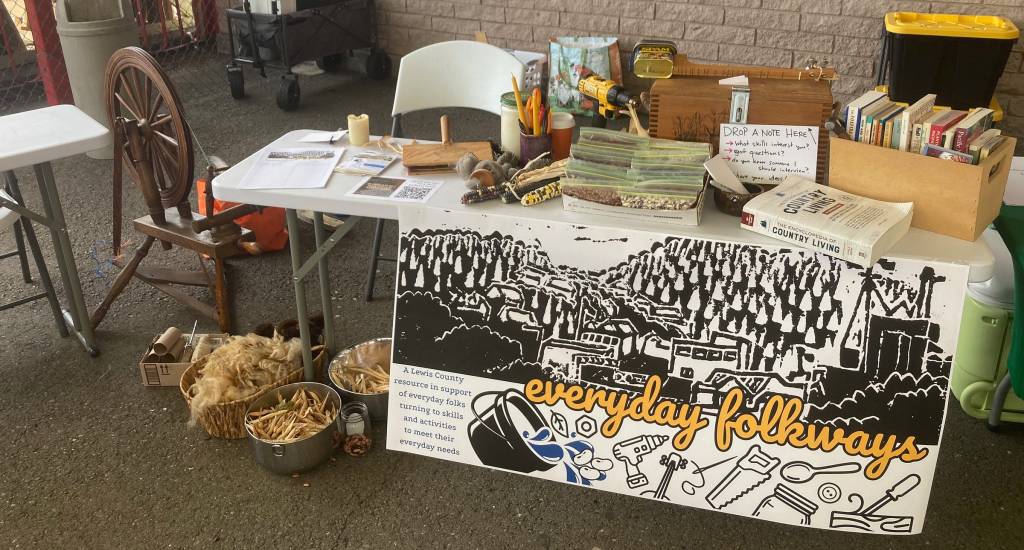
A couple highlights from the fair:
First, if you do not know about the MRC Tool Bucket Library, you SHOULD. They have nearly 2,000 tools you can borrow: from a chicken plucker to an asparagus knife to an anvil to an apple press. A basic membership is $45 for a year, or else $7 for a month. Please go learn more about it, or skip to browsing tools here if you want.
Second, if you’re in the Toledo area, you should know about Thrive Toledo. They’re “a local, non-partisan skill-sharing meetup focused on expanding our practical, everyday resiliency and connectivity.” ‘Nuff said.
There’ll be another MRC Repair Fair at Chehalis Outfitters on October 10th, so don’t miss that one.
Next, here’s a glimpse of this month’s project circle at Nature Nurture. We knitted, made a mess and some candles, fixed a banjo, made some lavender satchels, did some spinning with a couple drop spindles. It’s the last Saturday of every month, and is a space to get together around projects and needs-meeting activities. There’s no agenda beyond that, just an excuse to productively hang. See y’all June 30th!

Finally, a garden update. Remember those little egg carton beebs? Just ate some of that luscious lettuce with dinner this evening, and they’re rocking it out in their raised beds. And then those fledgling gourd starts? All leafy, big, and starting to climb. A green, happy success!

Alright, that’s all for now! Go check out the podcast and resources below, and as always: feel free to reach out to me at everydayfolkways@gmail.com, or else comment here.
EF Podcast 02: John Gregory Crafts with Wood

This month, we get to meet John Gregory, a local jointer here in Adna. What’s a jointer? Don’t be lazy – listen to find out! John is an up-and-coming traditional craftsman with good perspective on both how to enjoy being new at something, and what it’s like to seriously develop a craft. If you are woodcraft curious, chances are you’ve got space: John’s own woodcraft journey started in a 700 sq. ft. apartment. Check out a couple of the resources he recommends, get a handful of tools, and get started!
Listen to the podcast here: EF Podcast 02
Follow-Up Info…
A few of those resources John highlighted:
Rex Krueger youtube channel (Make it fun!)
James Wright Wood By Wright How To youtube channel (Do it fancy)
Paul Sellers youtube channel (That other great youtuber)
Eoin Reardon youtube channel (That young Irish TikToker)
Christopher Schwarz books (That Anarchist Woodworker)
Knives for spoon carving: Morakniv 106 and 164
We talked about a lot that didn’t make this podcast. Here are a few highlights:
When you are planing or whittling wood, it is easiest to do so with the grain of the wood. The grain runs in the direction the tree grows, and so when you are slicing the wood, you want to be slicing “up the tree.” Slicing wood the wrong direction, against that grain, is a lot like petting a cat backward. It sort of works, but no one is happy about it.
Everything is a chisel! A chisel is one of the most basic wood working tools. It’s a blade with wedge-shaped cutting edge at its end. When you push it along the wood, it slices it away in strips. A hand plane? A chisel in a frame, held at an exact angle. A drill? A specialized, twisted chisel. A saw? Hundreds of little chisels in line. In a manner of speaking, John pointed out that most tools he uses are either some form of chisel, a hammer, or a measuring device.
In addition to being a good word, holdfasts are cool, elegant, and simple. John explained them to me, but they’re best understood when seen in action. Check out how they work in this short clip!
I also really enjoyed watching (and listening to) John’s hand planing. It’s worth looking up a video to see them in action. Here’s Paul Sellers for your enjoyment.
…and Lessons Learned:
I gave John’s project suggestion a try, and ended up with a delightful new wooden spatula that has already seen action. Here’s what I ended up doing and learning.
Low Roman…Coffee Table:
My coffee table with a big, old board worked fantastically as one of those low roman workbenches that John described. Check it out! I was able to kneel on the board and work easily in the middle of my living room, and not worry a bit about sawing into my coffee table. If I were to do it again, I would put a towel or old blanket beneath the board just to make sure I didn’t scuff up my coffee table. All the same, it went unscathed this time.

A coping saw is totally worth it:
Boy howdy what a difference a coping saw makes. It’s like drawing on wood, and makes an annoying task a breeze. I got mine as suggested at a garage sale for like $3, and just saw them new at a local hardware store for $12-$15.

Chisels are probably worth it, too:
I did go out and buy a useful knife, after my multitool and (yes,) kitchen knife proved wanting. I did not go buy a chisel, though, and should have. The amount of time it takes to “waste out” wood with a knife made me wish I had a chisel for sure. Next time.
I remembered a few tricks; also, be careful please:
There is a kitchen tool that is actually useful on wood, though! That microplane that you use for cheese and nutmeg was accidentally invented by folks planning to make a wood rasp. I’m not necessarily recommending this, and you should check with whoever you share your kitchen with – but it totally works.
Wrap sandpaper around a chopstick (or whatever stick) and it works nicely to get into corners and hard-to-reach spots. I was also pretty proud of figuring out a couple useful ways to sand my spatula on my official living room workbench.
Always carve away from yourself – but there are some times that it doesn’t make sense to do so. In that case, be very careful and hold your hands together so that if the knife does skip, there’s not the freedom for the blade to skip into your flesh. If this technique is unfamiliar to you, just always cut away from yourself and/or do some research. I’m not prepared to keep you safe here from my ‘lessons learned’ section.
Last, it worked great to pick up mineral oil from the drug store, slop it onto an old rag, and scrub that oil into my new spatula. As another wood-working friend once told me: put enough coats of oil on it until you think it’s enough, and then do more. Err on the side of over-doing it.

Community Resources and Events:
Resource Links for Needs-Meeting Activities in and Around Lewis County
- Community Garden Resources and Free Seed Library at NNF
- Classes and Workshops at Nature Nurture Farmacy
- Master Recycler Composters (MRC) of Lewis County’s Tool Bucket Library
- Timberland Regional Library of Things, including Chehalis’ Gadget Library
- Lewis County Master Gardeners
- Washington Acoustic Music Association (WAMA)
- Washington Old Time Fiddlers Association (WOTFA)
- LC Solid Waste Utility Community Events
- Hub City Bike Shop
- Thrive Toledo
- …reach out with any suggestions (that’s the point!)
A Few Upcoming Activities & Events: (Calendar Coming Soon)
- Wed, June 10th Arts and Crafts Club at Owl and Cedar in Centralia (5:30 – 7:30PM)
- Fri, June 12th Bitters Making Class at NNF (5:30PM)
- Sat, June 13th Bees for Beginners at NNF (1:00PM)
- Sun, June 14th Old Time Jam at the Juice Box in Centralia (1-4PM)
- Sat, June 20th Gluten Free Baking Class (11:00AM)
- Wed, June 24th Arts and Crafts Club at Owl and Cedar in Centralia (5:30 – 7:30PM)
- Sat, June 30th Everyday Folkways Project Circle at Nature Nurture Farmacy in Chehalis (10:30 – 1:30PM)
Thanks! If you’d like, you can ask for more:
Leave a Reply